
Facts checked as of 24 Nov 2026 (SGT). The 2.6% concessionary rate is for 1 October to 31 December 2026 and is reviewed quarterly, so please confirm the latest official rate, and your own eligibility, with HDB, CPF and the bank before you sign.
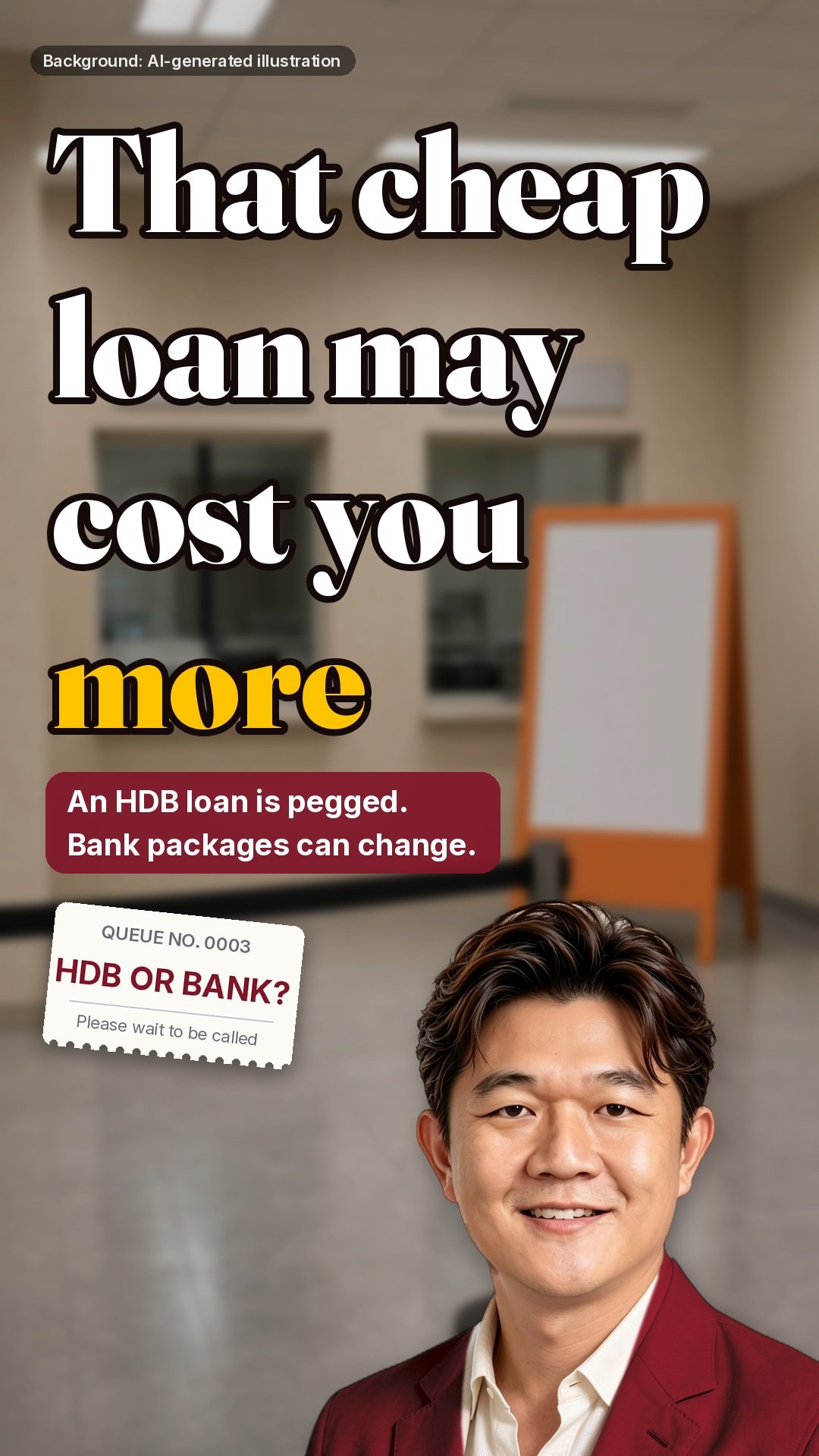
Bank loan or HDB loan? When you are buying a flat, the cheaper-looking package is not always the kinder one. I would rather you pick the rate you can live with, especially if this flat is a long stay, than chase today’s promo.
What is the HDB concessionary rate now?
An HDB concessionary loan is pegged at 0.1 percentage point above the CPF Ordinary Account rate.
According to a CPF Board news release on 22 September 2026, the Ordinary Account interest rate stays at the 2.5% floor from 1 October to 31 December 2026. Correspondingly, the concessionary interest rate for HDB housing loans remains at 2.6% a year for that quarter. The Ordinary Account rate, and therefore the HDB peg, is reviewed every quarter.
That is why I do not describe the HDB rate as “fixed forever.” It has been stable while the Ordinary Account rate sits at its floor, but it is still a peg, reviewed on a timetable.
Why a bank package can look cheaper, and still move
A bank housing loan can look cheaper on day one. That can be a genuine short-term saving, especially if you only plan to keep the flat for a few years and then move on.
It is not automatically the gentler choice for a long stay. The CPF Board’s 12 June 2026 explainer notes that bank housing loans may be floating, pegged to a benchmark such as the Singapore Overnight Rate Average (SORA), or fixed for a pre-determined period, usually one to three years, before reverting to floating. Those rates are subject to market fluctuations.
The same official article gives a historical illustration, not a forecast and not a current rate: in the low-rate period of 2020 and 2021, some homeowners secured mortgage rates below 1.5% a year; in 2022 and 2023, some borrowers saw mortgage rates exceed 4% a year. I am repeating that only as history, so you can see that bank rates can move. It is not a prediction of what will happen next.
Ask yourself the question the CPF Board puts to buyers: if repayments rose by a few hundred dollars a month, could your finances absorb it?
Lock-in is the other difference
An HDB loan has no lock-in period, so there is no penalty if you want to pay it off early. You can also refinance it to a bank at any time, subject to the bank’s approval.
Most bank loans, by contrast, have a lock-in, typically around one to three years. If you repay early or refinance during that period, there is usually a penalty. The CPF Board says that could be around 1.5% of the outstanding loan, although terms vary by bank and package, so treat that 1.5% as indicative, not a standard fee. There can also be legal fees, valuation fees, and clawbacks of subsidies or rebates.
One more rule that catches people out: once you refinance an HDB loan to a bank, you cannot switch back to an HDB loan. You also cannot refinance a bank loan into an HDB loan.
Downpayment and how much you can borrow
The rate is only one part of the comparison.
For an HDB loan, the CPF Board says the downpayment is at least 25% of the purchase price, and it can be paid in full with your CPF Ordinary Account, with cash, or with a mix of both. Monthly housing loan repayments cannot exceed 30% of your gross monthly income, which is the Mortgage Servicing Ratio.
For a bank loan, the downpayment is also 25%, but 5% is payable in cash and the remaining 20% can be cash or CPF Ordinary Account savings. Bank loans are subject to both the Mortgage Servicing Ratio and the Total Debt Servicing Ratio, which means your total monthly debt obligations cannot exceed 55% of your gross monthly income.
If you take an HDB loan, you must use the available Ordinary Account savings for the purchase before the loan is granted, though you can choose to retain up to $20,000 in the Ordinary Account as a buffer for monthly repayments. If you take a bank loan, you can retain any amount in the Ordinary Account and choose to pay in cash instead.
So how should you decide?
If this flat is a long stay, and you want a rate you can plan around, the HDB peg is built for that kind of stability. If the flat is only a stepping stone, a cheaper bank package for a few years can make sense, but only if you have read the lock-in, and only if you can live with the rate when the fixed period ends.
Sources
- CPF Board, 22 September 2026, interest-rate news release
- CPF Board, 12 June 2026, HDB loan or bank loan? 3 differences you should know
Direct HDB housing-loan pages returned 404 on the day these facts were checked, so I have stayed with the CPF Board pages that loaded.
If you want to compare your options, WhatsApp me on 8989 4720.
General information only, not financial or property advice.
Jax Tan | CEA R055464F | ERA Realty Network Pte Ltd | L3002382K | 8989 4720