
Facts checked as of 24 Nov 2026 (SGT). This is general education, not a personal cash-flow plan. Please confirm the latest CPF, HDB and bank rules, and your own expenses, before you decide how to split cash and CPF.
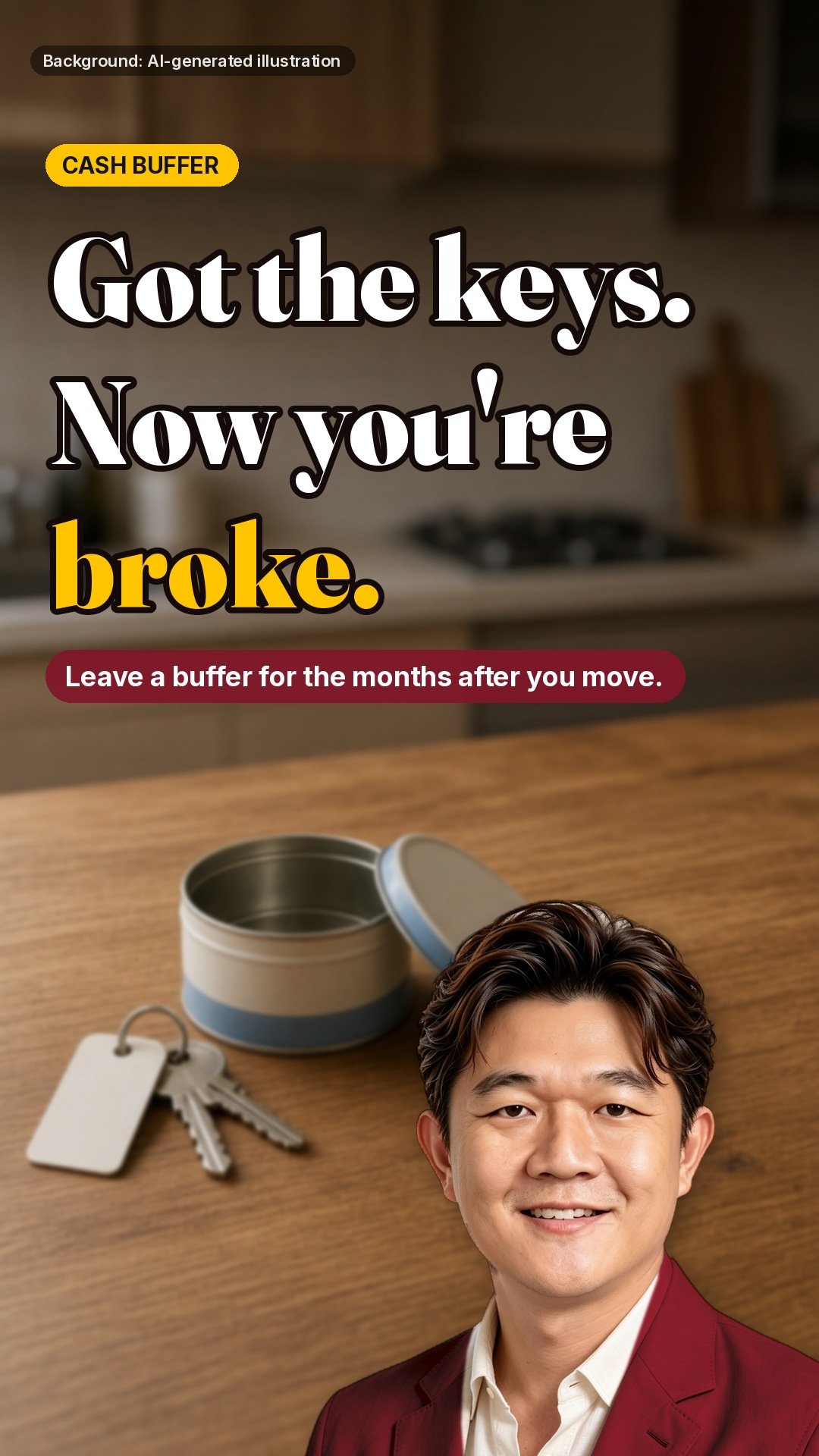
Putting every last dollar into the downpayment can feel safe. The loan looks smaller, the monthly instalment looks lighter, and it feels like you have “done the responsible thing.” Then one tight month comes, and the tin is empty.
You still have a loan to service after you collect the keys. Life can get bumpy after you move: a quieter stretch of work, a family expense, a few months of higher bills, and the instalment still has to be paid.
What MoneySense suggests
MoneySense, the official financial-education site, says to set aside 3 to 6 times your monthly expenses as emergency funds. In the same budgeting checklist, monthly expenses include debts such as loan repayments and credit-card balances. So the buffer is meant to cover the life you actually have after you move, not only food and utilities.
That is guidance, not a law. I still think it is the right place to start, because a slightly larger loan is often easier to live with than a household with no cash left.
If your income is irregular, the Basic Financial Planning Guide, which the Monetary Authority of Singapore developed with the industry, suggests aiming for savings equivalent to 12 months of expenses. That is a higher bar, and it is meant for people whose income does not come in evenly.
A useful option if you take an HDB loan
If you take an HDB loan, the CPF Board says you must use the available savings in your Ordinary Account for the purchase before the loan is granted. You can, however, choose to retain up to $20,000 in the Ordinary Account. Those savings can serve as an emergency fund to cover monthly repayments.
That $20,000 option is for HDB loans. It is not a rule I would apply to a bank loan. If you take a bank loan, the CPF Board says you may retain any amount in the Ordinary Account and choose to pay the instalment in cash instead.
Either way, the point is the same: leave something behind that can service the loan if a month gets tight.
Don’t make the downpayment look smaller just for the sake of it
A larger downpayment can reduce the loan, and that can be a good move if you still have a proper buffer left. The mistake is emptying the tin to make the loan look prettier on day one, then discovering that the keys in your hand came with no cash behind them.
Frequently asked questions
Is a 3 to 6 month emergency fund a legal requirement?
No. It is MoneySense guidance. I still use it as a starting point, because the buffer is meant to cover your actual monthly expenses, including the loan, after you collect the keys.
Does the $20,000 Ordinary Account option apply if I take a bank loan?
No. The CPF Board describes that “retain up to $20,000” option in the context of an HDB loan. If you take a bank loan, you may retain any amount in the Ordinary Account and choose to pay the instalment in cash instead.
Do I have to keep the buffer in cash, or can it sit in CPF?
If you take an HDB loan and retain up to $20,000 in the Ordinary Account, the CPF Board says those savings can serve as an emergency fund to cover monthly repayments. A cash buffer still matters for expenses that CPF cannot pay. The right split depends on your loan type and your household bills.
Sources
- MoneySense, Managing your money, last updated 28 September 2026
- CPF Board, 12 June 2026, HDB loan or bank loan? 3 differences you should know
- Basic Financial Planning Guide
If you want to sense-check your cash buffer before you sign, WhatsApp me on 8989 4720.
General information only, not financial or property advice.
Jax Tan | CEA R055464F | ERA Realty Network Pte Ltd | L3002382K | 8989 4720